Google I/O 2026 for Agentic Engineers: Seven Verticals, One Catch-Up Strategy
A postmortem of Google I/O 2026 filtered through the agentic-engineering lens. Every announcement that matters for builders, with my analysis on each. The thesis: Google is catching up on every vertical, and surface area is doing the rest.
Three years of saying Google was finished
Rewind to February 2023. Microsoft has just bolted ChatGPT into Bing. Satya Nadella is on stage at Redmond and again, days later, in a now-famous interview with The Verge. The line everyone in the industry remembered:
“I want people to know we made them dance.” Satya Nadella, The Verge, February 2023
“Them” was Google. The dance was Google’s emergency all-hands response to the threat of a generative-AI Bing. For most of 2023 and 2024 the consensus thickened: Google was a search-ads dinosaur whose business model could not survive generative AI. Every quarter the case got louder.
Aravind Srinivas, Perplexity’s CEO, made the cleanest version of the argument:
“Google can’t lead the AI search revolution due to ad revenue dependence.” Aravind Srinivas, multiple interviews, 2023–2025
He sharpened it later with a different framing. Perplexity has had two years, he kept saying, and Google has not killed them. The implication was an innovator’s dilemma in plain sight: Alphabet could not pivot Search to answers without putting a knife to its own ~$198B-a-year ad-search revenue. Sundar Pichai kept writing blog posts about generative AI in Search; Google kept not shipping the obvious thing.
Then the theatre got expensive. In August 2025, after Judge Amit Mehta’s antitrust ruling against Google, the DOJ proposed forcing Google to divest Chrome. Perplexity, valued at $18 billion at the time, bid $34.5 billion for Chrome. Almost double its own valuation. Backed by named investors. Framed as “an antitrust remedy in the highest public interest.” Whether the bid was serious or theatrical, the message was unmistakable: smaller players believed Google’s distribution moat was about to be pried open by force, and they were willing to put $34 billion on the table to be the ones who walked through the gap.
That was the narrative entering 2026. Google is vulnerable. Google cannot pivot. Google’s distribution is decayable. Google is finished in the agentic era.
Three days ago, Google held its 2026 I/O keynote. They showed up on every vertical the doubters said they could not.
- Their own chip generation (TPU v8t for training, v8i for inference).
- Their own model family topped by the fastest frontier-class model in the industry (Gemini 3.5 Flash, 289 tokens per second).
- Their own coding agent platform at feature parity with Claude Code (Antigravity 2.0, CLI + SDK + harness + Managed Agents).
- Their own personal agent with a $100/mo price reset (Spark, on MCP).
- Their own agentic Search at 1 billion monthly users.
- Their own commerce protocol stack with Amazon, Meta, Microsoft, Salesforce, and Stripe signed on.
And underneath all of it, the surface area Satya Nadella tried to make dance is bigger than it has ever been. AI Overviews alone hit 2.5 billion monthly users. The Gemini app doubled to 900 million MAU in twelve months. Google’s market cap is up roughly 4× since the dance comment.
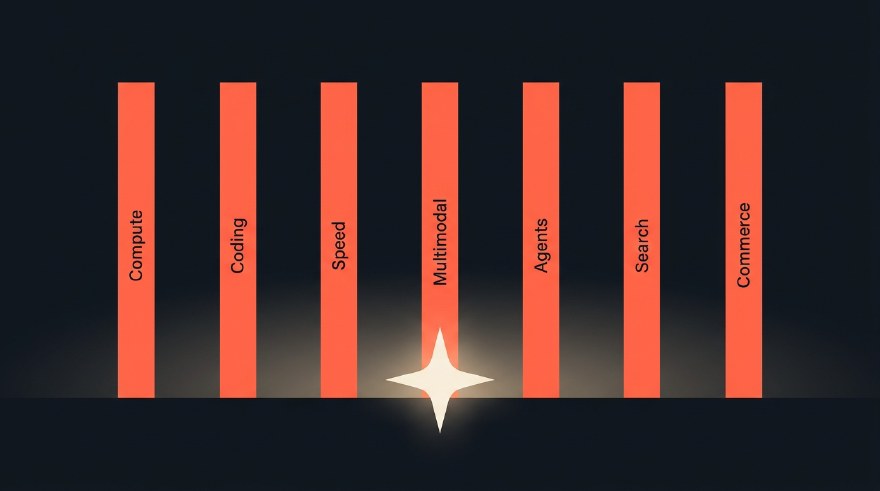
This post is the agentic engineer’s read on what Google did with the three years everyone said they were finished. It walks the I/O 2026 keynote in chronological order, beat by beat, with my analysis on each, filtered through one lens: the seven verticals that matter to people who build agentic software for a living. The consumer-app stuff (Daily Brief, Stitch, Google Pics, Flow Music), the hardware (Audio Glasses, Project Aura), the AI-for-science section, were on stage too. They are not in this post. None of them changes the cost function of building agents.
The ones that do are in here. There are seven of them. They tell one story.
If you want the ten-minute opinionated version, the YouTube companion is I Was Wrong About Google. Their Agent Strategy Is the Smartest in Tech on The Agentic Engineer. This post is the long-form receipts.
The surface advantage, in numbers
Sundar opened the keynote with the numbers you build the rest of the analysis on. There are six that matter.
| Metric | Value |
|---|---|
| Tokens processed by Google services per month | 3.2 quadrillion (~7× last year) |
| Developers building on Google AI APIs | 8.5 million+ monthly |
| Google products with 1B+ users | 13 (five with 3B+) |
| AI Overviews monthly active users | 2.5 billion+ |
| AI Mode monthly active users | 1 billion+ (within a year of launch) |
| Gemini app monthly active users | 900 million+ (doubled from 400M in 12 months) |
“We are taking a differentiated, full-stack approach to AI innovation. From our custom silicon and secure foundation, to our world-class research and models, to our products and platforms that reach billions of people.” Sundar Pichai, Google I/O 2026 keynote [02:44]–[03:08]
Read that quote twice. The first three quarters of it is the part every frontier lab can say. The closing phrase is the part only Google can. AI Overviews alone has more monthly users than every Anthropic surface combined times something north of two orders of magnitude. That is not a vanity stat. It is the multiplier the rest of the keynote pours into.
Now look at what Google poured into it.
Vertical 1: Compute (TPU v8t and v8i)
What shipped: A new TPU generation with a deliberate split. TPU v8t is the training chip, roughly 3× the compute of the prior generation. TPU v8i is the inference chip, optimized separately for low-latency serving. Google said it now trains across more than one million TPUs globally.
What it means: This is the announcement nobody covers because it is not consumer-facing. It is also the announcement everything else in the keynote sits on top of.
Three Gemini surface refreshes in a single calendar year does not happen unless the compute floor moves. A model priced for high-volume agentic loops (the entire next section is about this) does not happen unless inference is cheap to serve at scale. The v8t/v8i split is the architectural admission that training and inference are now different workloads with different unit economics, and Google is willing to ship two chips to win both.
Anthropic does not have a chip. OpenAI does not have a chip. Both rent capacity from someone who would rather sell to themselves. That is not a death sentence. Frontier capability still mostly tracks model architecture and data, not silicon. But it is a structural cost disadvantage that compounds every quarter Google ships a chip generation and the others ship a procurement contract.
If you build agentic software, you will feel this in pricing, not in benchmarks. Which brings us to the next vertical.
Vertical 2: Model speed (Gemini 3.5 Flash)
What shipped: Gemini 3.5 Flash is the new default across every Gemini surface. The numbers Sundar put on stage:
- 289 tokens per second output throughput
- ~4× faster than other frontier models
- $1.50 per 1M input tokens, $9.00 per 1M output, $0.15 cached input
- 1M-token context window
- 76.2% Terminal-Bench 2.1, 83.6% MCP Atlas, 84.2% CharXiv Reasoning, outperforms Gemini 3.1 Pro on the agentic + coding cluster despite being the Flash tier
This is the most important announcement of the keynote for the median agentic engineer, and it is the one most of the recaps under-played.
What it means: The dominant narrative of the last eighteen months has been “smarter is better.” Every frontier release has been benchmarked against the prior frontier release on hard reasoning. Every model selector in every coding agent defaults to whatever has the highest GPQA score this week.
That narrative was wrong for most workloads. Most agentic work is not hard reasoning. It is tool-calling loops. Pick the right tool. Format the arguments. Read the result. Decide the next step. Repeat thirty times.
I have shipped a lot of this code. Sathi, the agent that drives my LinkedIn / X / Reddit on a Mac mini in the corner, runs hundreds of decisions a day. Each decision is one to two hundred tokens of reasoning, one tool call, fifty to two hundred tokens of result parsing. The model’s job is to be right enough, not brilliant. The cost function looks roughly like this.
total_cost = decisions × (tokens_per_decision × price_per_token)
total_latency = decisions × (tokens_per_decision / tokens_per_second + tool_round_trip)
Both of those formulas are dominated by the per-token terms when the per-decision token budget is small. Flash at 289 TPS and $1.50/M input crushes a frontier model at 60 TPS and $15/M input on workloads where the median decision is two hundred tokens. The frontier model has more IQ per token. It does not have more IQ per second, and it does not have more IQ per dollar.
A small back-of-envelope table for how this plays out across common agentic workloads.
| Workload | Median decision tokens | What dominates the bill |
|---|---|---|
| Browser automation (Path 3 atomic tools) | 100–300 | Tokens/sec + price/M. Flash wins decisively. |
| Code generation (Copilot-style completion) | 200–600 | Tokens/sec. Flash wins for inline; Pro/Opus only for hard refactors. |
| Multi-step research agent | 500–2K per step | Mixed. Flash for the loop, escalate to Pro for the synthesis step. |
| One-shot hard reasoning (proof, derivation) | 5K–20K | Per-token IQ. Opus/Pro tier wins. |
| Long-context document QA | 50K+ context, ~500 output | Context price. Cached input on Flash ($0.15/M) is the structural advantage. |
The last row matters more than people give it credit for. Cached-input pricing at fifteen cents per million tokens is the thing that makes a 1M-context model economically usable for agentic loops that re-read the same large context twenty times in a session. The Anthropic equivalent (Claude Sonnet 4.6 with prompt caching) is in the same ballpark, but Flash being the default model rather than a tier-up unlocks this for every workload by default.
The frontier model has more IQ per token. It does not have more IQ per second, and it does not have more IQ per dollar.
The strategic read on Flash is: Google does not need to win the IQ-per-token race. Flash exists to make the IQ-per-second race a one-horse race, and that race is the one most agentic loops are actually running. If you are building an agent that does anything other than write proofs for a living, Flash is now your default. And “Google made the default model” is a sentence worth re-reading.
Vertical 3: Multimodal (Gemini Omni)
What shipped: Gemini Omni, framed as a “world model.” It generates video, audio, and images from any combination of text, image, audio, or video inputs. Two tiers: Omni Flash (consumer-facing, 10-second clip cap at launch, free on YouTube Shorts) and Omni Pro (longer durations, Pro/Ultra tier). Developer API is coming “in a few weeks” via Vertex AI and the Gemini API. The world-model framing is about cause-and-effect: Omni understands gravity and kinetic energy well enough to preserve character and scene continuity across multi-turn edits, which the prior generation could not.
graph LR
    O["Gemini Omni"] --> F["Omni Flash
(free)"]
    O --> P["Omni Pro
(Pro/Ultra tier)"]
    F --> S["YouTube Shorts
creative tool"]
    F --> Y["YouTube Create app"]
    P --> G["Gemini app
(paid tiers)"]
    P --> FL["Google Flow
(filmmaking tool)"]
    P --> API["Developer API
(Vertex AI + Gemini API)
shipping in weeks"]
    style API fill:#FF5A4E,stroke:#FF5A4E,color:#0B0F14
    style O fill:#F5F0E8,stroke:#5A544B,color:#0B0F14
    style F fill:#F5F0E8,stroke:#FFB020,color:#0B0F14
    style P fill:#F5F0E8,stroke:#FFB020,color:#0B0F14
    style S fill:#F5F0E8,stroke:#5A544B,color:#0B0F14
    style Y fill:#F5F0E8,stroke:#5A544B,color:#0B0F14
    style G fill:#F5F0E8,stroke:#5A544B,color:#0B0F14
    style FL fill:#F5F0E8,stroke:#5A544B,color:#0B0F14
What it means: The consumer story (Omni Flash going straight into YouTube Shorts on launch day, free) is the one the video covers. It is the cleanest single-announcement evidence of the diffusion thesis. Read the companion YouTube video for that beat.
The agentic-engineering story is the developer API. Omni is the first frontier multimodal model where media generation becomes a first-class tool output. Today, if your agent needs to produce a UI mock, a voiceover for a video summary, or a short demo clip as part of its workflow, you are stitching together three different APIs and praying. With Omni in the Gemini API, that becomes one model call, one billing line, one latency budget.
The agents that will most benefit are the ones that produce things people watch or look at: tutorial-generation agents, sales-deck agents, support-video agents, design-iteration agents. Those workloads are about to get materially cheaper to build. The video is the surface bet; the API is the developer bet. Both ship.
Vertical 4: Coding (Antigravity 2.0)
What shipped: This is where the catch-up math gets pressure-tested, so I am going to spend the most time here.
Antigravity 2.0 is Google’s standalone agentic dev platform. At I/O 2026 Google shipped:
- An updated desktop application built entirely around agent orchestration.
- A brand-new Antigravity CLI, written in Go (faster and more responsive than the previous Gemini CLI it replaces).
- An Antigravity SDK for custom workflows.
- An Agent Harness with new core primitives: subagents, hooks, and asynchronous task management.
- Managed Agents in the Gemini API.
- Enterprise support through the new Gemini Enterprise Agent Platform.
- MCP-native tooling with schema validation at the extension level.
Varun Mohan (Antigravity lead, formerly of Codeium) put the receipt on stage:
“Building an entirely functional operating system consumed less than $1,000 of API credits.” Varun Mohan, Google I/O 2026 keynote [28:53]
Ninety-three parallel subagents. Fifteen thousand model requests. 2.6 billion tokens. Twelve hours wall clock. A working OS from scratch. Under a thousand dollars.
What it means: The popular take on I/O 2026 has been “Google still didn’t ship a Claude Code competitor.” That take is wrong. Antigravity 2.0 is the Claude Code competitor, and it matches Claude Code feature-for-feature on the primitives that actually matter.
Here is the head-to-head, as honestly as I can write it.
| Capability | Claude Code (Anthropic) | Antigravity 2.0 (Google) |
|---|---|---|
| Harness surfaces | CLI terminal | Desktop app + CLI (Go) + SDK |
| Model lock-in | Claude family only | Gemini 3.5 family only |
| Subagents | Yes (first-class) | Yes (Agent Harness primitive) |
| Hooks | Yes | Yes (Agent Harness primitive) |
| Async task management | /loop, /schedule, background tasks |
Async task management primitive |
| MCP support | Yes (host + server) | Yes, native (schema validation at extension level) |
| Voice input | Limited | Native via Gemini audio models |
| Cross-surface integration | Terminal-only | Android · Firebase · AI Studio |
| Enterprise platform | Anthropic Console | Gemini Enterprise Agent Platform |
| Managed cloud agents | Background tasks via API | Managed Agents in the Gemini API |
| Pricing | Pro/Max $20–$200/mo | AI Pro / AI Ultra ($100/mo, $200/mo heavy tier) |
| Origin-story anecdote | “Claude Code wrote Claude Code” | “Built an OS in 12h for <$1K” |
Twelve rows. Read each one. There is no row where Anthropic has a primitive Google does not. There is one row (model lock-in) where both vendors are equally locked. There is one row (surfaces) where Google has materially more (desktop + CLI + SDK vs CLI alone). Voice and cross-surface are Google-favoured. Everything else is parity.
For ten months the channel’s contrarian beat (ep04, I Stopped Building MCP Servers) leaned on the assumption that no third party would build a Claude Code-class agentic harness. That assumption broke at I/O 2026, on stage, with receipts. The dev-tool gap is not invention. The dev-tool gap is which model you trust and which install base reaches you.
Anthropic invented Claude Code. Google did not have to invent. They had to match, and they did.
For an agentic engineer choosing a daily driver in May 2026, the honest call goes like this. If you trust Claude’s coding quality more (Opus 4.7 still benchmarks ahead on hard refactors), Claude Code. If you trust Gemini 3.5’s price-performance more (and you should, for high-volume loops, see Vertical 2), Antigravity. If you work in a Google-shop enterprise where Gemini Enterprise is procured already, Antigravity by default. Pick by model, not by feature list. The harness is now a tie.
Vertical 5: Personal agents (Gemini Spark, OpenClaw)
What shipped: Gemini Spark is a 24/7 personal AI agent running on cloud VMs. It works across Gmail, Sheets, Slides, Drive, and a growing list of third-party apps (Canva, OpenTable, Instacart at launch, more in weeks). Third-party integrations go through MCP. It synchronizes between Android and iPhone. Spark runs on the Gemini 3.5 Flash model with Antigravity as the underlying framework. Gating: Google AI Ultra subscribers ($100/mo after the I/O 2026 price cut from $250; a $200/mo “heavy” tier still exists). US-only at beta launch this week, broader rollout to follow.
What it means: Two things land here, and both are channel-thesis validations.
The first is MCP, again. Back in ep05 of The Agentic Engineer I argued that MCP wins specifically for multi-tenant, multi-vendor connectors, the cases where the cost of a proprietary spec is higher than the cost of a slightly less perfect open one. Spark is the loudest possible validation of that read. Google did not build a Spark-proprietary integration spec. They picked MCP. When the largest distribution surface in agent land picks the open protocol, the open protocol stops being “the standards play” and becomes “the reach play.” If you are building a third-party connector for any agentic platform in the next 12 months, you ship MCP first.
The second is the price reset. AI Ultra went from $250 to $100 in the same keynote that launched Spark. That is not coincidence. Google is buying agent-platform mindshare on price. ChatGPT Plus is $20, Claude Pro is $20, ChatGPT Pro is $200, Claude Max is $100–$200. At $100, Spark sits in the middle of the band but bundles a 24/7 cloud agent that none of the others ships at any price. Whether that bundle wins depends on whether Spark is actually good (the keynote demos were tightly choreographed; real verdicts will take a month of use). But the pricing aggression alone tells you Google is willing to subsidize agent-platform usage to win the standalone consumer-agent vertical.
For an agentic engineer, Spark is interesting less as a product to use and more as a landing pad for MCP servers you write. The third-party apps Spark integrates with (Canva, OpenTable, Instacart) are MCP servers. If your SaaS does not have an MCP server in 2026, you are one Spark-launch cycle away from being a missing tile in the integration grid. Write the server.
The third thing worth flagging is that Spark is one specific shape of the personal-agent pattern. Google’s shape. Closed-source, vertically integrated, $100 a month, gated to one model family. The same category has an open-source shape too: brain plus hands across apps, where the agent reasons and tools execute, and the protocol surface (skills, hooks, plugins) is something the community can extend rather than something a single vendor controls. That open shape is the design I steward as the maintainer of OpenClaw, the OSS agent framework I started in 2025. If Spark is the version Google ships, OpenClaw is the version you ship. The architecture, the design choices, and where it goes from here are the full subject of Episode 02 of The Agentic Engineer: Meet OpenClaw. Spark and OpenClaw are two answers to the same question. They will coexist, and they will both be right for different builders.
Vertical 6: Agentic Search
What shipped: Three layers, all under Liz Reid’s segment.
- AI Mode at 1 billion monthly users within a year of launch, now powered by 3.5 Flash. Conversational search, expanding query box, accepts images / files / videos / Chrome tabs as inputs.
- Information Agents that work 24/7 monitoring the web and Google’s real-time data, proactively alerting users when something they care about changes. Summer rollout for AI Pro / Ultra.
- Generative UI / Mini Apps rendered inline in search results: custom dashboards built on the fly for one query (flight-price tracker, restaurant-opening monitor, live sports scores).
What it means: Search is the largest agent platform on earth, measured by surface. There is no Anthropic equivalent at any scale that matters, and there cannot be one short of an Anthropic-search-engine pivot that is not coming.
The strategic read: Google is no longer treating Search as a query box that needs an LLM bolted onto the answer card. They are treating it as a runtime for agents. Information Agents are background processes. Generative UI is a per-query mini-app sandbox. The Mode container is the shell. If you squint, AI Mode is the first agent operating system to ship with a billion users pre-installed, eighteen months ahead of anyone else’s billionth user.
For agentic engineers, the implication is uncomfortable. The next billion-user consumer agent is not going to be a new app. It is going to be an agent embedded inside a surface someone uses every day, where the install cost is zero. AI Mode is the canonical case. The next one will be a Workspace agent, or an Android Halo background process, or a Chrome extension that ships with the browser. The standalone-app playbook for consumer AI has a ceiling, and that ceiling is roughly Gemini app’s 900M MAU. Going past it requires distribution that nobody outside Google, Apple, Microsoft, and Meta has.
Build inside surfaces. Or build the protocol the surfaces speak (more on that in the next vertical).
Vertical 7: Agentic commerce (UCP + AP2 + Universal Cart)
What shipped: The agentic commerce stack came together at this I/O. Three components, all moving from “spec on Google slides” to “live infrastructure with named partners.”
- Universal Commerce Protocol (UCP). Founding partners added at I/O: Amazon, Meta, Microsoft, Salesforce, Stripe. Sixty+ organizations in the ecosystem. Expanding to hotels, local food delivery, YouTube. Adding Canada, Australia, UK in coming months.
- Agent Payments Protocol (AP2). Cryptographically signed “digital mandates” provide a tamper-proof audit trail from user → merchant → payment processor. Ships into Gemini Spark next month.
- Universal Cart. A cross-merchant shopping cart that runs across Search, Gemini, YouTube, and Gmail simultaneously. Tracks deals, price drops, stock alerts. Does compatibility checks (the PC-build example: motherboard ↔ CPU). Applies Google Wallet payment perks. US rollout summer 2026.
Sundar’s framing line:
“UCP does for agentic commerce what HTTP did for the web: it gives agents and systems a common language.” Sundar Pichai, keynote [59:47]
What it means: In ep06 of The Agentic Engineer I drew the four-layer agentic commerce stack on a whiteboard.
graph TB
    subgraph EP06["What I drew in ep06 (January 2026)"]
        U1["UI layer
(MCP Apps)"]
        C1["Cart layer
(UCP)"]
        A1["Auth layer
(AP2)"]
        M1["Money layer
(card / RTP / stablecoin rails)"]
        U1 --> C1 --> A1 --> M1
    end
    subgraph IO26["What shipped at I/O 2026 (May 2026)"]
        U2["MCP Apps in Spark
(30+ third-party)"]
        C2["Universal Cart
(Search, Gemini, YouTube, Gmail)"]
        A2["AP2 mandates
(cryptographically signed)"]
        M2["Google Wallet rails
(60+ merchant ecosystem)"]
        U2 --> C2 --> A2 --> M2
    end
    EP06 -.->|"4 months"| IO26
    style C2 fill:#FF5A4E,stroke:#FF5A4E,color:#0B0F14
    style A2 fill:#FF5A4E,stroke:#FF5A4E,color:#0B0F14
    style U1 fill:#F5F0E8,stroke:#5A544B,color:#0B0F14
    style C1 fill:#F5F0E8,stroke:#5A544B,color:#0B0F14
    style A1 fill:#F5F0E8,stroke:#5A544B,color:#0B0F14
    style M1 fill:#F5F0E8,stroke:#5A544B,color:#0B0F14
    style U2 fill:#F5F0E8,stroke:#5A544B,color:#0B0F14
    style M2 fill:#F5F0E8,stroke:#5A544B,color:#0B0F14
Four months later, the middle two layers shipped, with name-brand partners, into four Google surfaces simultaneously.
Two things are worth saying out loud about this. First, the partner list matters more than the protocol. UCP without Amazon and Stripe is a Google whitepaper. UCP with Amazon and Stripe is the closest thing the agent ecosystem now has to an actual cross-vendor commerce standard. Second, the agentic commerce play is a diffusion play disguised as a protocol play. Universal Cart is not a new app you have to install. It is a cart that shows up inside Search results when you ask Search to find you a thing. The protocol layer (UCP + AP2) is the open part. The cart layer is the proprietary distribution layer Google is going to win by virtue of owning the surfaces it runs on.
For agentic engineers, the build advice is: bet on the protocols, build into the cart. UCP and AP2 are the vendor-neutral pieces. If you sell goods or services through any agent surface in the next 24 months, you need a UCP-compatible product catalog and AP2-signed mandates. Whether your agent surface of choice ends up being Google, Anthropic, OpenAI, or someone independent, you want the same protocols underneath. Build to the spec, then plug into whoever ships first. Google shipped first.
What Google did not ship
The contrarian beat. Every honest postmortem needs one.
- Open weights. Google did not release a single open-weight model at this I/O. Anthropic has not either, but neither has anyone with a frontier model. The open-weight wave is happening at the next tier down (Meta, Mistral, Qwen, DeepSeek), and Google’s response is silence.
- Cross-vendor model support in Antigravity. Antigravity 2.0 is Gemini-only. You cannot swap in Claude Opus for the hard reasoning step, the way some Claude Code users swap in OpenAI’s o-tier for specific tasks. The harness is open in shape; the model selector is not.
- A standalone consumer chat surface independent of Google services. Spark is for Google Workspace users. The Gemini app is for everyone, but it bundles Google account assumptions. If you live outside Google’s identity ecosystem (and a surprising number of Anthropic and OpenAI users do), most of the I/O 2026 announcements simply do not reach you.
- A Pixel-only feature lockup. This one cuts the other way. Google had every opportunity to gate Android Halo, the macOS Gemini app, or Spark to Pixel devices to drive hardware sales. They did not. Every agent feature ships cross-device. This is on-strategy for the diffusion play but worth noting because Apple would have made the opposite call.
What it means: Every omission is on-strategy. Google diffuses into the surfaces they already own and avoids the surfaces they do not. The open-weights gap leaves room for the next-tier model labs to build a real open ecosystem. The Anthropic-model-swap gap leaves room for Claude Code as the cross-vendor harness, which is a real moat for Anthropic if they invest in it. The non-Google-identity gap leaves room for whichever consumer agent ships next that does not require a Google login.
If you are an indie builder, the omissions are where you live. The catch-up is real on the verticals Google plays. The verticals Google does not play, Google does not play.
The catch-up math
Now go back to the dance comment.
Stack the seven verticals one more time, this time with the strategic read on each, against where Google was when Satya Nadella made his “make them dance” joke.
| Vertical | Where Google was (2023, “make them dance” era) | Where Google was at I/O 2026 | The Anthropic-equivalent surface |
|---|---|---|---|
| Compute | Internal TPU, mostly hidden | TPU v8t + v8i, dual-chip architecture, 1M+ TPUs globally | Rented capacity |
| Model speed | Bard on PaLM, slow + uncompetitive | 3.5 Flash at 289 TPS, $1.50/M input, default model | Haiku 4.5 (smaller surface) |
| Multimodal | Image gen only, weak video | Omni world model + dev API in weeks | None at frontier |
| Coding | None standalone | Antigravity 2.0 desktop + CLI + SDK + harness + Managed Agents | Claude Code |
| Personal agent | Bard chat | Spark, cloud agent, 30+ MCP apps, $100/mo Ultra | Claude.ai (chat only) |
| Search | Classic 10 blue links + featured snippets | AI Mode 1B MAU + Information Agents + Generative UI | None |
| Commerce | None | UCP + AP2 + Universal Cart, 60+ partners, 4 surfaces | None |
Five of seven rows have no Anthropic equivalent at the surface layer. Two of seven rows (model speed, coding) have an Anthropic equivalent that is roughly at parity or better on benchmarks. Zero of seven rows show Anthropic ahead at the combined model + surface layer.
This is the catch-up math, stated plainly.
- In 2023, the consensus was that Google could not pivot, could not reinvent, would be cannibalized by their own ad revenue.
- In 2025, Perplexity was bidding $34.5 billion for Chrome on the assumption that Google’s distribution moat was already cracking.
- At I/O 2026, Google is at parity or close on every vertical where Anthropic also competes, ahead on multiple verticals where nobody competes, and the distribution moat is bigger than it has ever been.
- For most agentic workloads, speed and cost matter more than peak intelligence, and Flash is built for exactly that.
- Google’s surface area is approximately three orders of magnitude larger than Anthropic’s, and growing.
- Therefore: catching up to parity on the model layer, paired with a 1000× distribution multiplier, looks an awful lot like winning.
This is a refinement, not a contradiction, of the line my YouTube companion lands on.
In the agent era, distribution beats invention.
It is not that Google invented better. They mostly did not. Anthropic still has the more loved brand among agentic engineers and a sharper independent identity. Perplexity still has the cleanest answer-engine UX. OpenAI still has the consumer brand. What Google has is good-enough invention on every vertical, paired with surfaces a billion people already live inside. That combination is the catch-up math. It works because both halves of the multiplication are now non-trivial.
The honest pressure-test on this thesis is the good-enough clause. If a future Anthropic or OpenAI release opens a real model-quality gap (the kind a Pro-tier user can feel in five minutes), the math changes. Distribution is a multiplier, not a substitute. Right now, on the workloads that matter, the gap is not there. That can change. Watch for it.
But this much is fair to say in May 2026: nobody is making Google dance anymore.
What this means for builders
Three concrete plays. They are the same three the video lands on, but with the texture the video could not carry.
1. For consumer-facing agents, build inside Gemini’s surfaces. The next billion-user consumer agent will not be a standalone app. It will be embedded somewhere people already are. The places to build are now well-defined: Search via Generative UI mini-apps, Workspace add-ons, Chrome extensions, Android Halo background processes, and the Spark third-party app slot via MCP. Distribution is free if your agent is a citizen of one of these surfaces. The build cost is learning the surface-specific extension model, which is real but bounded. The reward is reach you cannot buy.
2. For developer-facing agents, pick Claude Code or Antigravity by model, not by features. The harness gap has closed. Claude Code and Antigravity 2.0 both have CLI, both have subagents, both have hooks, both have async, both speak MCP. Pick the daily driver that runs the model you trust on the work you do. If you write a lot of code that needs hard reasoning (deep refactors, novel algorithms, ambiguous specs), Claude with Opus 4.7 still has the edge per token. If your work is high-volume agentic loops (tool-calling, UI automation, doc QA), Antigravity with 3.5 Flash will be cheaper and faster for almost all of it. The decision is now a model decision, not a tooling decision.
3. For protocol-layer bets, build to the open spec, plug into whoever ships first. MCP is now multi-vendor (Anthropic + Google + others). UCP and AP2 are multi-vendor by Sundar’s own framing. If you sell goods, write a UCP-compatible product catalog. If you accept agent payments, support AP2 signed mandates. If you ship a SaaS, run an MCP server. The pattern is the same in all three cases: build to the protocol once, ship into whichever surface adopts first. The protocols are the vendor-neutral leverage. The surfaces will trade places over the next decade. The protocols will not.
Pick a surface. Build a tool. Ship to the protocol. That is how you ride the catch-up math without picking a side in the model wars.
The pairing with the video
That is the keynote, filtered through the agentic-engineering lens, with the seven verticals that actually move the cost function of building agents this year.
The ten-minute opinionated version is on YouTube as I Was Wrong About Google. Their Agent Strategy Is the Smartest in Tech. The video makes the case in one sentence. This post makes it in seven thousand words and twelve quotes.
Next on the channel: the opposite bet. Anthropic took a different path to the agent era, same goal, different strategy. That episode is up next on The Agentic Engineer. If this post was useful, subscribe, and tell me on LinkedIn which vertical you think I got wrong.