The Agentic Engineer Weekly, Issue 09: The frontier repriced, and Anthropic blinked first
GPT-5.6 shipped at a third of Fable 5's cost and claimed 54% better token efficiency. Anthropic reset every user's limits within hours, and open weights kept pace. Issue 09 of The Agentic Engineer Weekly.
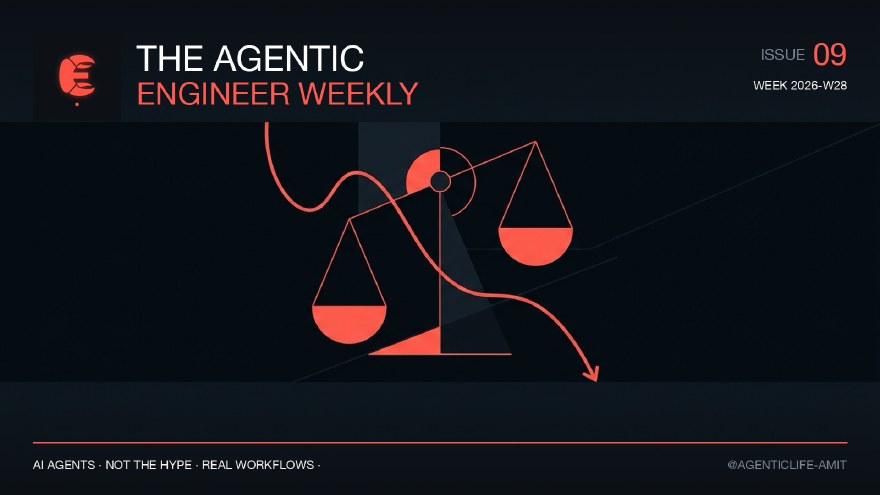
The frontier repriced, and Anthropic blinked first
For a year the frontier debate was about who was smartest. This week it stopped being about that. OpenAI shipped the GPT-5.6 family after a two-week government hold, and the number it led with was not a capability score. It was 54% better token efficiency on agentic coding, Terra at $2.50/$15 per Mtok, Luna at $1/$6, and Sol claiming the top of the Artificial Analysis coding index at roughly a third of Fable 5’s cost. Within hours Anthropic reset every user’s five-hour and weekly limits worldwide, a retention move so naked that the top Reddit comment just said “Thanks, OpenAI.” If you run agents for a living, the takeaway is simple: your daily-driver economics are now being set by two companies in a pricing panic, and the winning metric is cost per outcome, not the headline benchmark.
The week in five bullets
- GPT-5.6 (Sol, Terra, Luna) went generally available, leading on token efficiency and cost, not raw intelligence, and set an ARC-AGI-3 record along the way.
- Fable 5 left the Claude subscription for usage credits at $10/$50 per Mtok, and Anthropic answered the GPT-5.6 launch with a same-day global limit reset.
- Open weights stayed on the frontier’s heels: GLM-5.2 crowned the best open model, Kimi K2.5’s PARL agent-swarm paper, Ornith’s self-scaffolding coders, and Nvidia’s fully open Nemotron 3 Ultra.
- The MCP 2026-07-28 spec hit release candidate with a stateless core, Tasks, and MCP Apps, even as builders complained the tool schemas are quietly eating their context budgets.
- The through-line all week was cost and orchestration: Fable-orchestrates-Sonnet at 96% of performance for 46% of the spend, execs “horrified” by agent bills, and the review of AI code becoming the real bottleneck.
Top of mind
GPT-5.6 lands, and the frontier flips on cost, not capability
OpenAI pushed Sol, Terra, and Luna to general availability on July 9 after a US Commerce Department review held the launch back two weeks for extra CAISI testing. Sol is the frontier tier at $5/$30 per Mtok, Terra at $2.50/$15 and Luna at $1/$6 undercut hard, and OpenAI claims Terra and Luna beat Fable 5 on Agents Last Exam at roughly a sixteenth of the cost. Sol topped the Artificial Analysis coding index at 80 (about 2.8 over Fable 5) using under half the tokens, set an ARC-AGI-3 record as the first model to win a full game, and shipped with a Sol-generated proof of the Cycle Double Cover Conjecture that pulled 300-plus points on Hacker News.
The verdicts from builders were remarkably consistent, and they were not about intelligence. Dan Shipper called it a Porsche where Fable is a warp drive: not smarter, but fast, reliable, and pleasant enough that teams report 5x the token usage. The counter-signals matter just as much. Prompt caching on sol, terra, and luna appears broken, so you pay the 1.25x cache-write fee and the credits never land. Sol regressed on SimpleBench. And Plus users burn a full session’s limit in about twelve minutes of Sol Ultra, whose harness reportedly fans out 200-plus subagents for a simple research task.
Why it matters: The number that moves your monthly bill is cost per agentic task, and that is exactly the curve OpenAI is now winning. This is worth a real head-to-head against your Claude Code loops, caching bug and all, not a headline skim.
Fable 5 leaves the plan, and Anthropic answers with a reset
The other half of the story is what happened on Anthropic’s side of the ledger. Fable 5’s promotional inclusion in Pro, Max, Team, and Enterprise plans, capped at 50% of weekly usage, was supposed to end July 7. After a 1,300-upvote revolt from people who had burned their weekly limits “tokenmaxxing” what they thought was the last day, Anthropic quietly extended it to July 12 with no blog post, then let it move to usage credits at $10/$50 per Mtok, roughly double Opus 4.8. The community read the extension exactly right: timed to blunt GPT-5.6’s rollout.
Then GPT-5.6 dropped, and hours later Anthropic reset every five-hour and weekly limit globally. Cowork limits doubled through August 5. The subtext under the 1,363-point thread was less charitable than the headline: the consensus was that users will jump to Sol on cost alone, even if Fable is better. Fable also caught a possible post-safeguard regression, with one re-run showing debugging scores falling from 86.2 to 25.9, likely the new classifier refusing rather than the model degrading.
Why it matters: Your daily pipelines run on this subscription, and its economics are being set by competitive reflex right now. This is a good week to lock in workflows that degrade gracefully across Fable, Opus 4.8, and Sol rather than betting on any one lab’s pricing mood.
Open weights refuse to be a sideshow
While the two closed labs traded blows, the open tier had its densest week in months. GLM-5.2 (744B MoE, about 40B active, MIT license) is being crowned the current best open-source model, with MiniMax M3 and an agentic, MCP-native Qwen 3.6-Plus rounding out the open frontier. Nvidia’s Nemotron 3 Ultra may be the most open frontier-adjacent model yet, shipping weights, paper, and redistributable training data under a permissive license, strong on agentic and terminal work if weak on hard coding. Tencent’s Hy3 (295B MoE, 21B active, Apache 2.0) ran frontier-competitive on a 128GB MacBook and made the Hacker News front page.
The research inside those releases is the part worth a study session. Moonshot’s Kimi K2.5 paper details PARL, parallel-agent reinforcement learning, where a trained orchestrator drives hundreds of frozen sub-agents and is penalized on the longest-running branch rather than agent count, landing 3 to 4.5x faster on wide-search tasks. Deep Reinforce’s Ornith 1.0 (9B to 397B, all open) trains models to write their own task-specific harness before solving, with a three-layer anti-reward-hacking stack. Meta confirmed an open-source Muse Spark variant is coming too.
Why it matters: With Sol’s caching still broken and Fable now metered, the open tier is where the cheap experimentation is. And “self-scaffolding” plus trained orchestrators are direct shots at the harness engineering many of us still do by hand.
MCP goes stateless, and its context cost starts to show
The Model Context Protocol reached release candidate this week, with the final spec due July 28. It is the largest revision since launch: a stateless core that runs behind plain round-robin load balancers with no sticky sessions, an Extensions framework, a Tasks extension for long-running work, MCP Apps for server-rendered UIs, OAuth and OIDC-aligned authorization, and a formal deprecation policy. FastMCP already published its migration plan, and the ten-week SDK validation window is running.
The candid counter-note arrived the same week. Builder threads are open about the tax: “MCP tool schemas are quietly eating my context budget,” with one hygiene tool, lap-score, measuring Notion’s MCP server at roughly 21K tokens consumed before you type a word. The emerging patterns are scoping secrets with per-tool MCP tokens instead of a shared .env, and routing bounded work to local models to stop burning frontier tokens on plumbing.
Why it matters: Every remote MCP server you build after July inherits the stateless shape, so design against the RC now. And as you wire more servers into daily jobs, schema bloat is a real per-request tax worth measuring before your context fills with tool definitions.
The harness became a training target, and reviewing the output became the job
The connective tissue across all seven days was cost and orchestration, and the two are now the same conversation. Anthropic published first-party numbers showing a Fable 5 orchestrator with Sonnet 5 workers keeping 96% of all-Fable performance at 46% of the cost, reproducible in Claude Code today via subagent model frontmatter and a delegation policy. The sharp gotcha in that thread: since v2.1.198 the built-in Explore subagent inherits your main-session model, so a Fable or Opus daily driver pays top-tier rates for background searches unless you shadow Explore with a haiku-pinned agent.
Meanwhile the benchmarks people quote started to wobble. OpenAI audited SWE-Bench Pro, found nearly a third of tasks broken, and retracted its recommendation, awkward timing given Grok 4.5’s launch charts leaned on the same benchmark. Databricks answered with the alternative everyone is converging on: eval on your own multi-million-line codebase with tasks from your own engineers. And the weekend’s most honest thread was a developer admitting he spends 4x longer reviewing AI code than reviewing a junior’s worse code. Writing is no longer the bottleneck. Reading is.
Why it matters: The instrumented-token-spend habit you built for your own pipelines is about to be a mainstream discipline with a job title, and the review bottleneck is the next thing your tooling has to solve.
Agentic engineering and tooling
- Claude Code shipped almost daily, from v2.1.202 through v2.1.207: auto mode is now the default on Bedrock, Vertex, and Foundry, the long-standing terminal freeze on big streamed tables is fixed, and
/doctorbecame a full setup checkup that will offer to trim a bloated CLAUDE.md. - Claude Code now refuses to fill password fields, breaking some automated QA audits even inside disposable containers, with no override. A safety default with real friction for agentic testing.
- Claude Code desktop gained an in-app browser that opens any site with no Chrome extension, closing the verify-loop gap under strict org extension policies.
- Cursor 3.11 added Side Chats (
/side,/btw) for parallel conversations with full context, a local index across thousands of past chats, and cloud-agent hooks (beforeSubmitPrompt,afterAgentResponse,afterAgentThought) that make the agent lifecycle something you can gate. - OpenAI’s Responses API got programmatic tool calling (the model writes code that orchestrates tools in-memory) and a multi-agent beta, bringing Anthropic’s code-execution playbook to the other ecosystem.
- Anthropic’s cookbook merged a “plan big, execute small” coordinator pattern; LangChain fully open-sourced OpenSWE, a cloud coding-agent factory you tag from Slack, GitHub, or Linear.
- Databricks found a minimal bash-tools agent was about 2x cheaper than Claude Code or Codex with a higher pass rate on its own codebase. Less harness, more model.
Models
- Grok 4.5, the first SpaceXAI and Cursor co-trained model, went public at $2/$6 per Mtok with terminal-bench around 83 and a token-efficiency pitch (about 16K output tokens per task). Note the footnote: an old Cursor codebase snapshot leaked into training.
- Meta’s Muse Spark 1.1 hit terminal-bench 80 at $1.25/$4.25, and Meta confirmed an open-source variant is coming.
- Gemini 3.5 Pro is previewed for later this month with a 1M-token window and a reported 100% on AIME 2025 with code execution.
- Reality check from llm-stats: roughly one new model every three days. GLM-5.2 and GPT-5.6 are the two that actually mattered.
Chips and infra
- Nvidia reaffirmed its roadmap and rejected a SemiAnalysis delay report, saying Rubin is pulling about two quarters ahead of its 2027 slot; Blackwell is sold out through mid-2026.
- Samsung passed Nvidia as the world’s most profitable chip firm on a 19x quarterly profit jump, the memory supercycle being the quiet AI trade, and your local-rig RAM prices are the collateral damage.
- SK Hynix raised $26.5B in the biggest foreign IPO in US history and is being pushed to build US fabs; DeepSeek and Meta (the “Iris” chip, in production in September) both moved to cut Nvidia dependence.
Deals and money
- Anthropic passed OpenAI in secondary-market valuation for the first time, $965B to $852B, with both having confidentially filed for IPOs.
- Ollama raised $65M and now serves nearly 9M users; local inference is now a venture category. Together AI closed an $800M Series C at about $8.3B on the bet that enterprises want to own their open-source stack rather than rent it.
- Global venture funding hit a record $510B in H1 2026, per Crunchbase, driven by AI.
Consumer AI
- OpenAI shipped GPT-Live, a full-duplex voice model that listens while it speaks, free for all users, and is pushing ChatGPT deeper into households with family features.
- Anthropic released Reflect, a Wrapped-style recap of how you use Claude, which TechCrunch read as a retention feature dressed as wellness.
- Meta pulled a controversial Instagram AI generation feature after backlash; OpenAI is winding down its standalone Atlas browser and folding the ambition into the main app.
Research worth knowing
- AI swept the AtCoder World Tour Finals, with OpenAI’s model solving all five algorithm problems (no human managed more than three) and winning the heuristic contest; last year’s human champion called heuristic contests “very close to RSI.”
- Anthropic’s “global workspace” paper identified the J-space, a small emergent internal channel that higher-order reasoning causally depends on, and the community reproduced it on open models within hours.
- A cautionary datapoint for eval pipelines: an LLM judge scored a prompt change 9 out of 10 right before it broke production for 3% of users. Evals are not judges.
Worth your scroll
- Apple sued OpenAI over alleged coordinated trade-secret theft, naming its ex-Apple hardware chief and 400-plus former Apple staff. This is a hardware fight over the io device, not a model fight.
- A capybara game built with Claude Code made $25K, and someone rebuilt a $7,500-a-year structural-biology suite for free. The software-margins-are-melting genre continues.
- “Stop Telling Me to Ask an LLM”, the Hacker News pushback on “just ask the model” as a non-answer, is a healthy counterweight to the week’s hype.
What I’m watching next week
- The MCP 2026-07-28 final spec lands, and the Tier-1 SDKs start their ten-week support window.
- GPT-5.6’s broken prompt caching on sol, terra, and luna: whether OpenAI fixes it, since it quietly erases much of the cost advantage until it is.
- Gemini 3.5 Pro’s expected arrival this month, the one credible challenger to the OpenAI-versus-Anthropic framing above.
The Agentic Engineer Weekly is the Saturday companion to the daily morning AI briefing I write for myself. AI agents. Not the hype. Real workflows.
Watch the video episodes on YouTube at @agenticlife-amit. Follow me on X and LinkedIn. If a friend forwarded this, forward it to one engineer who would like it. If you want to talk back, find me on any of those.